
Publicaciones
Tema
Países
Tipo
Año
Buscar en
Protecting Community Rights and Interests in Carbon Projects: Guidance for NGOs supporting communities
This guide is designed for NGOs, grassroots and other solidarity organisations and legal experts supporting local communities, Indigenous Peoples, and other customary or community-based landholders in the Democratic Republic of Congo (DRC) who are approached by private developers seeking to undertake voluntary carbon market (VCM) projects on their land. These projects aim to generate carbon credits under international VCM standards (such as Verra’s VCS or Gold Standard), with the intention of profiting from the sale of credits in voluntary carbon markets.
Protecting Community Rights and Interests in Carbon Projects: Guidance for communities engaging with project developers
These checklists are a practical tool designed to help landholders and communities understand and protect their rights when a developer approaches them about a voluntary carbon credit project. It is intended for use in the Democratic Republic of Congo (DRC), where private developers seek to carry out such projects on community or customary land, with the aim of generating carbon credits for sale on international markets.
A Just Transition in the DRC
Drawing on local community experiences, the report by CORAP and the Notre Terre Sans Petrole campaign seeks to lay the political, legal and strategic foundations for a national dialogue on how the just transition in DRC can advance the rights and priorities of its people and support the country’s own transformation, rather than simply serving the needs of the global energy transition.
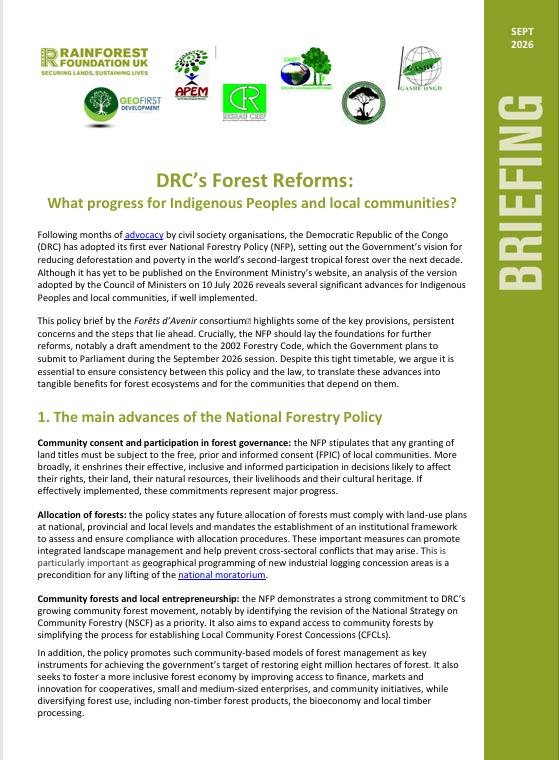
DRC’s Forest Reforms: What progress for Indigenous Peoples and local communities?
The Democratic Republic of the Congo (DRC) has adopted its first-ever National Forest Policy, setting out the government’s vision for forest governance over the next decade and introducing several important measures to strengthen the rights of Indigenous Peoples and local communities. This civil society brief examines its strengths, weaknesses and what needs to happen next.
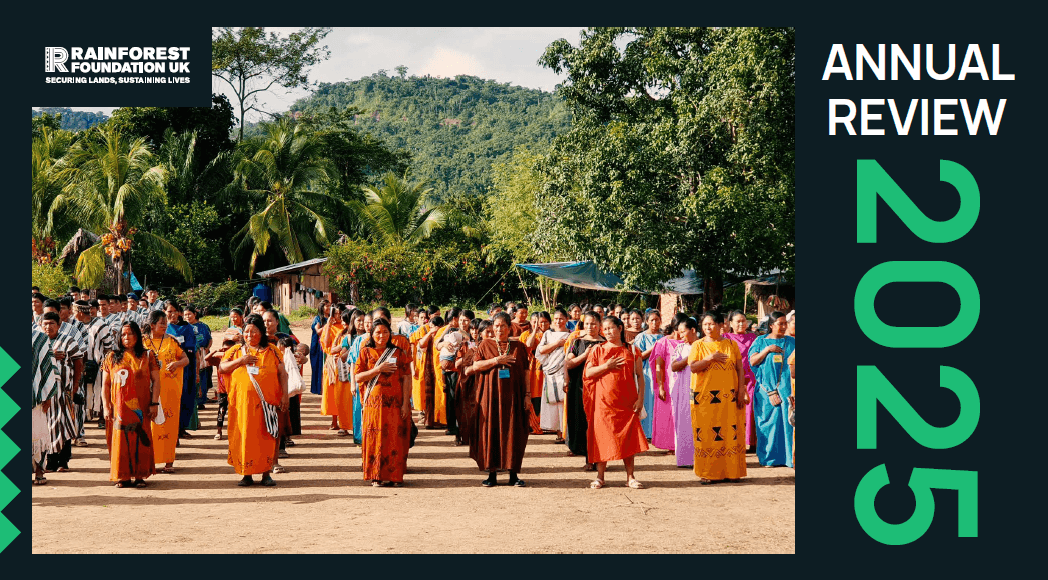
ANNUAL REVIEW 2025
We are delighted to present our 2025 Annual Review, which highlights the key achievements and impact of RFUK’s projects and campaigns over the past year in partnership with Indigenous Peoples and forest communities around the world.

LOGGING OFF: PLANS TO LIFT THE DRC LOGGING MORATORIUM THREATEN FOREST PROTECTION EFFORTS IN THE CONGO BASIN
A civil society briefing warning that plans to lift the DRC’s national logging moratorium could open vast areas of Congo Basin rainforest to industrial logging, threatening forests, climate goals and community rights, and calling for greater emphasis on community-led, sustainable forest management.

Visión para 2033: hacia una nueva era de protección de las selvas tropicales
Visión 2033: una nueva era en la protección de los bosques tropicales establece nuestra hoja de ruta para la próxima década de conservación de la selva tropical. Basada en más de 30 años de experiencia trabajando junto a los pueblos indígenas y las comunidades locales, esta visión describe cómo la combinación de acciones impulsadas por las comunidades con un cambio sistémico, tecnología innovadora y alianzas más sólidas puede impulsar medidas a la escala y con la urgencia que exigen las crisis climática y de biodiversidad.

RETHINKING THE JUST TRANSITION IN THE DRC
Focusing on voices from across the DRC, a so-called ‘Solutions Country’, this briefing highlights how current extractive and conservation models often harm communities, and sets out a pathway for a just transition rooted in equity, participation and community-led environmental stewardship.

Community Forests in DRC: a solution for a ‘solutions country’
A new Community Forestry briefing from RFUK, Congolese civil society and partners highlights how community forestry can help the DRC realise its ambition to be a true solutions country for climate and biodiversity.

NATURE, PEOPLE AND CARBON MARKETS: WHY ARTICLE 6 SHOULD SIDELINE THE TRADE IN NATURE-BASED CREDITS
This policy briefing calls on COP30 negotiators to exclude nature-based carbon offsets from global carbon markets and instead direct climate finance through non-market approaches that support Indigenous peoples and local communities as true stewards of high-carbon ecosystems.
 English English
 French
 Spanish