
Report

Veedurías Forestales para la Defensa de los Territorios Indígenas y la Conservación de la Naturaleza en la Amazonía Peruana
Full Spanish language publication of Veedurías Forestales para la Defensa de los Territorios Indígenas y la Conservación de la Naturaleza en la Amazonía Peruana: la Experiencia de la FENAMAD con el Sistema de Alerta Temprana ForestLink.

Executive Summary: Forest Observatories for the Defence of Indigenous Territories and the Conservation of Nature in the Peruvian Amazon
English and Spanish language Executive Summary: Forest Observatories for the Defence of Indigenous Territories and the Conservation of Nature in the Peruvian Amazon: the Experience of the Native Federation of Madre de Dios and the ForestLink Project.

CREDITS WHERE THEY ARE NOT DUE: A CRITICAL ANALYSIS OF THE MAJOR REDD+ SCHEMES
A first-of-its-kind comparative analysis that finds that world-leading forest offsetting and REDD+ schemes – used by some of the world’s biggest polluters – are failing forests by allowing millions of credits to be generated that simply do not represent real emissions reductions.
Carbon Offsetting and REDD+ Deconstructed
Paying poorer countries to protect their forests seems like a good idea for both the climate and sustainable development. However, the reality of reducing emissions from deforestation and degradation (REDD+) is often far more complex and difficult to navigate. This briefing unpacks some of the key issues with market-based REDD+, the alternatives that can unlock … Read more
30×30: the good, the bad and what needs to happen next
After years of intense international negotiations and delays, the Global Biodiversity Framework (GBF) has now been adopted but the final agreement is a mixed bag – while it contains some hard-fought guarantees for Indigenous Peoples and other local communities, core concerns about the “30×30” plan remain. Ultimately, governments have missed a huge opportunity for a … Read more

Congo in the Crosshairs: Oil and Gas Expansion Threats to Climate, Forests, and Communities
A new comprehensive mapping and analysis by RFUK and Earth Insight shows that oil and gas expansion in the Congo Basin is a rapidly accelerating existential threat to the global climate, and to the world’s second largest rainforest – including the tens of millions of people who live there. There is still time for African … Read more
Realising the Pledge: Unlocking System-level Change in the Congo Basin
Building on ‘Realising the Pledge,’ a briefing by the Rainforest Foundations of the United Kingdom, the United States and Norway on how the US$1.7 billion Forest Tenure commitment at COP26 can reach critical frontline forest defenders, this Brief looks at major opportunities to unlock system-level change in key tropical forest regions such as the Congo … Read more

Realising the Pledge: How Increased Funding for Forest Communities Can Transform Global Climate and Biodiversity Efforts
A briefing from the Rainforest Foundations of the United Kingdom, the United States and Norway for climate funders and policy makers on what it will take to realise the US$1.7 billion pledge on indigenous peoples and other local communities and to mainstream support to these groups in climate and biodiversity funding more broadly.
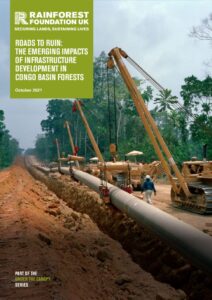
Roads to Ruin: The Emerging Impacts of Infrastructure Development in Congo Basin forests
A report by RFUK reveals the growing extent, and impact, of transport and energy infrastructure development in the Congo Basin – which is on its way to becoming a major driver of deforestation in the world’s second largest rainforest. The eight case studies featured in this report show that, while certain projects may bring some … Read more

Use It AND Lose It – Industrial Logging and its Role in Deforestation in the Democratic Republic of Congo
New research demonstrates a clear link between the establishment of commercial logging operations and a cascade of deforestation. Investigating forest loss in DRC across 60 logging concessions and eight ‘control’ areas, the findings from this study show that the selective logging of high-value timber species is not a sustainable form of forest management, but rather … Read more