
Haki Ardhi: transforming how women in Kenya claim their land rights
27 March 2026
Kakamega County, Kenya – A pioneering initiative is transforming how women in Kenya report and seek justice for their rights and access to land.
Haki Ardhi, a monitoring and reporting tool co-developed by Rainforest Foundation UK (RFUK), TMG Think Tank for Sustainability, Shibuye Community Health Workers (SCHW) and the Kenya Land Alliance (KLA), and funded by BMZ (the German Federal Ministry for Economic Cooperation and Development), [1] has emerged as a vital instrument in advancing women’s land rights and ensuring accountability.
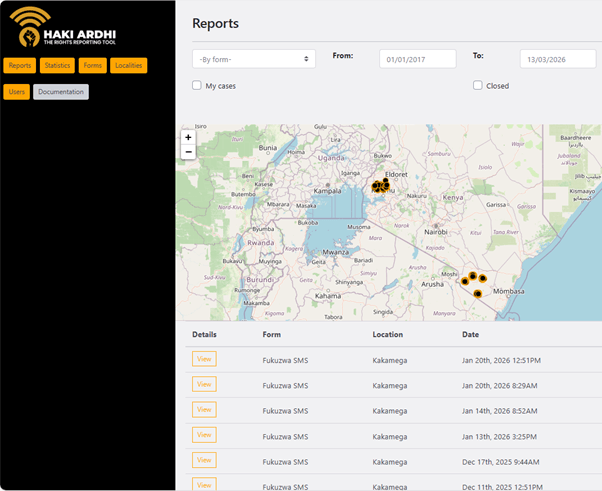
The Haki Ardhi monitoring tool provides women with a safe, accessible channel to report land‑related abuses and to quickly access legal and community support. It also helps local organisations digitise formerly paper‑based case files, improving follow‑up and enabling centralised data analysis to identify trends and drive evidence‑based policy reform.
Haki Ardhi’s data reveals widespread violations of women’s land rights across Kenya, with forced evictions and tenure insecurity among the most common abuses. Most cases occur within family and community settings and are frequently perpetrated by husbands or in‑laws, and widows are often disproportionately affected by being left out of inheritances. Many incidents involve gender‑based violence or coercion, underscoring the link between land dispossession and women’s physical safety, economic security and mental well‑being.
Using both SMS based and in‑person reporting, the tool systematically captures evidence of violations and fills critical data gaps left by institutions. By translating individual reports into legal referrals and policy advocacy, Haki Ardhi strengthens accountability and bolsters responses to entrenched land rights abuses.
During a recent field visit to Kakamega County, RFUK, TMG and SCHW met a woman who had successfully used Haki Ardhi to report her case. She submitted her report anonymously via text message, which was received by SCHW. Drawing on their expertise in women’s rights, land laws and survivor-centred gender‑based violence responses, SCHW then supported her in pursuing justice by providing psychosocial support, legal services and access to a lawyer.
“Haki Ardhi gave me a safe way to speak out. With Shibuye’s support, I now feel empowered not only to fight for my rights but also to help other women do the same,” the woman shared.
Her story reflects a growing trend: women who use Haki Ardhi are not only accessing justice but also becoming advocates within their communities. This combination of trusted, community-based support and a secure digital reporting tool encourages others to come forward to advocate for their owns rights and justice.
Violet Shivutse, SCHW Executive Director, highlighted the importance of community-driven solutions. “Women face unique challenges when it comes to land rights and gender-based violence. Haki Ardhi bridges the gap between survivors and justice mechanisms, ensuring that cases are documented, followed up and addressed.”
A video on the Haki Ardhi app by TMG — Think Tank for Sustainability.
RFUK, TMG, SCHW and KLA have jointly developed the Haki Ardhi Handbook, a practical guide designed for land rights defenders, community-based organisations, paralegals and national civil society groups engaged in advocacy and legal empowerment. Featuring clear, step-by-step instructions and visual guidance, the handbook is accessible to users with varying levels of literacy and experience, making it a practical resource both for those new to the tool and for existing users seeking to improve its use.
By combining digital innovation with grassroots expertise and community mobilisation, Haki Ardhi is setting a new standard for how technology can advance women’s rights and improve access to justice in Kenya.
For more information about RFUK’s work in Kenya and Haki Ardhi, please click here.
[1] Financial support from the Bundesministerium für wirtschaftliche Zusammenarbeit und Entwicklung (BMZ) (the German Federal Ministry for Economic Cooperation and Development).
Share this:


 English
  French
  Spanish