
Indigenous forest observers drive action against illegal mining in the Peruvian Amazon
10 April 2026
New results from the Madre de Dios region in southeastern Peru’s Amazon Basin show how Indigenous-led monitoring is protecting forests, influencing policy and confronting rising threats.
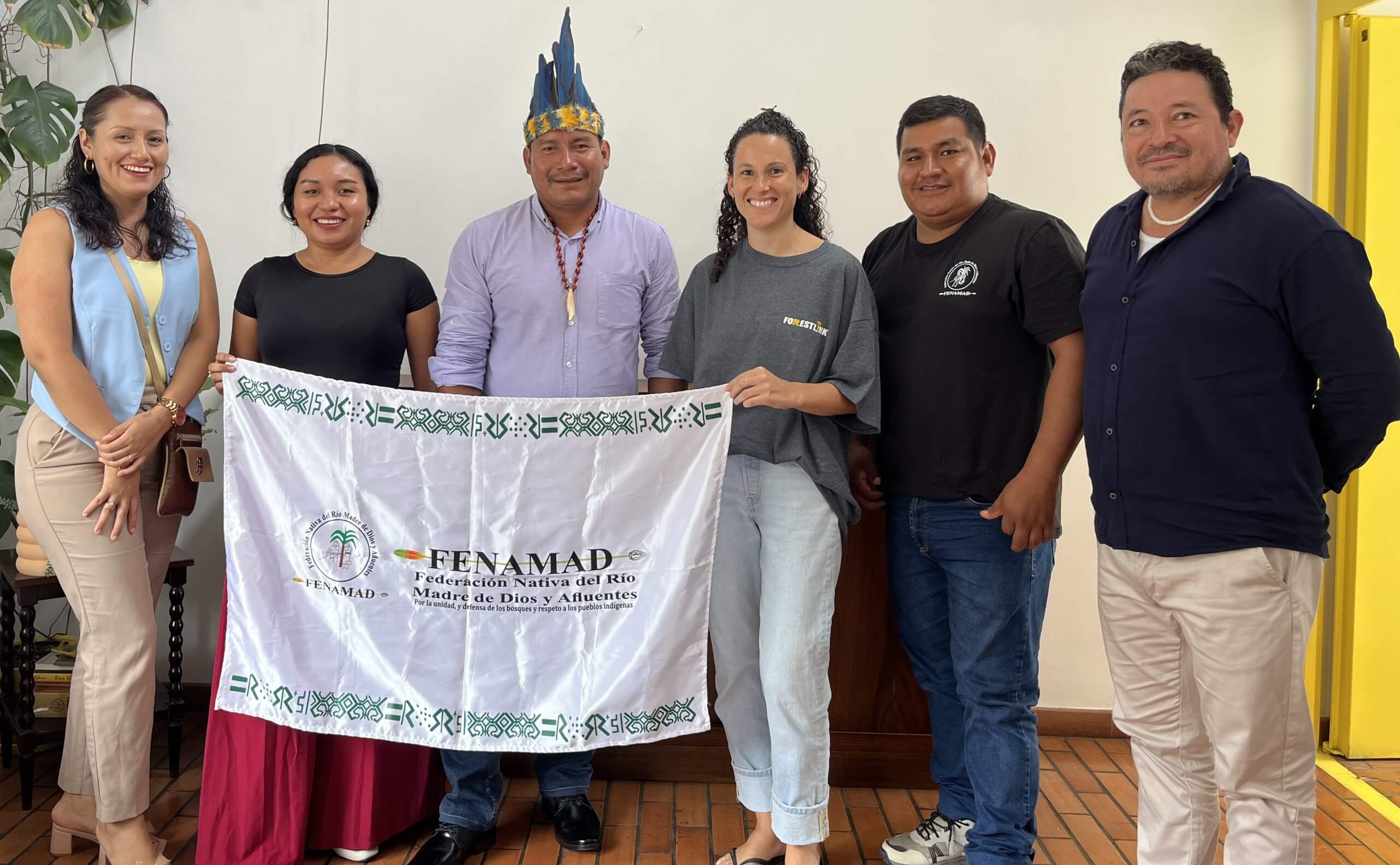
RFUK’s Peru Coordinator, Daniela Velit, recently visited Puerto Maldonado, the capital city of the Madre de Dios region, and saw first-hand how RFUK’s project alongside Indigenous rights organisation FENAMAD is increasing the impact of Indigenous forest monitoring across the Peruvian Amazon. New data shows how community-led systems are driving legal action, informing enforcement and shaping environmental policy. RFUK and partner FENAMAD provide Indigenous communities with technologies that allow them to monitor their territories at an unprecedented scale and turn evidence into action.
Monitoring at scale across Indigenous territories
Over the years, RFUK’s partnership with FENAMAD has steadily expanded Indigenous forest monitoring across the Madre de Dios region, from an initial 10 communities to near territory-wide coverage today. In the past year, this monitoring network has been significantly strengthened and consolidated. Today:
- up to 30 communities have active forest observer committees;
- 156 trained Indigenous observers are operating in the field;
- monitoring now covers over 500,000 hectares of rainforest.
This marks a major shift from isolated reporting to systematic, territory-wide forest protection led by Indigenous peoples.
From data to justice
However, monitoring alone does not create change. RFUK and FENAMAD's joint work has linked monitoring to real accountability, and in 2025 alone:
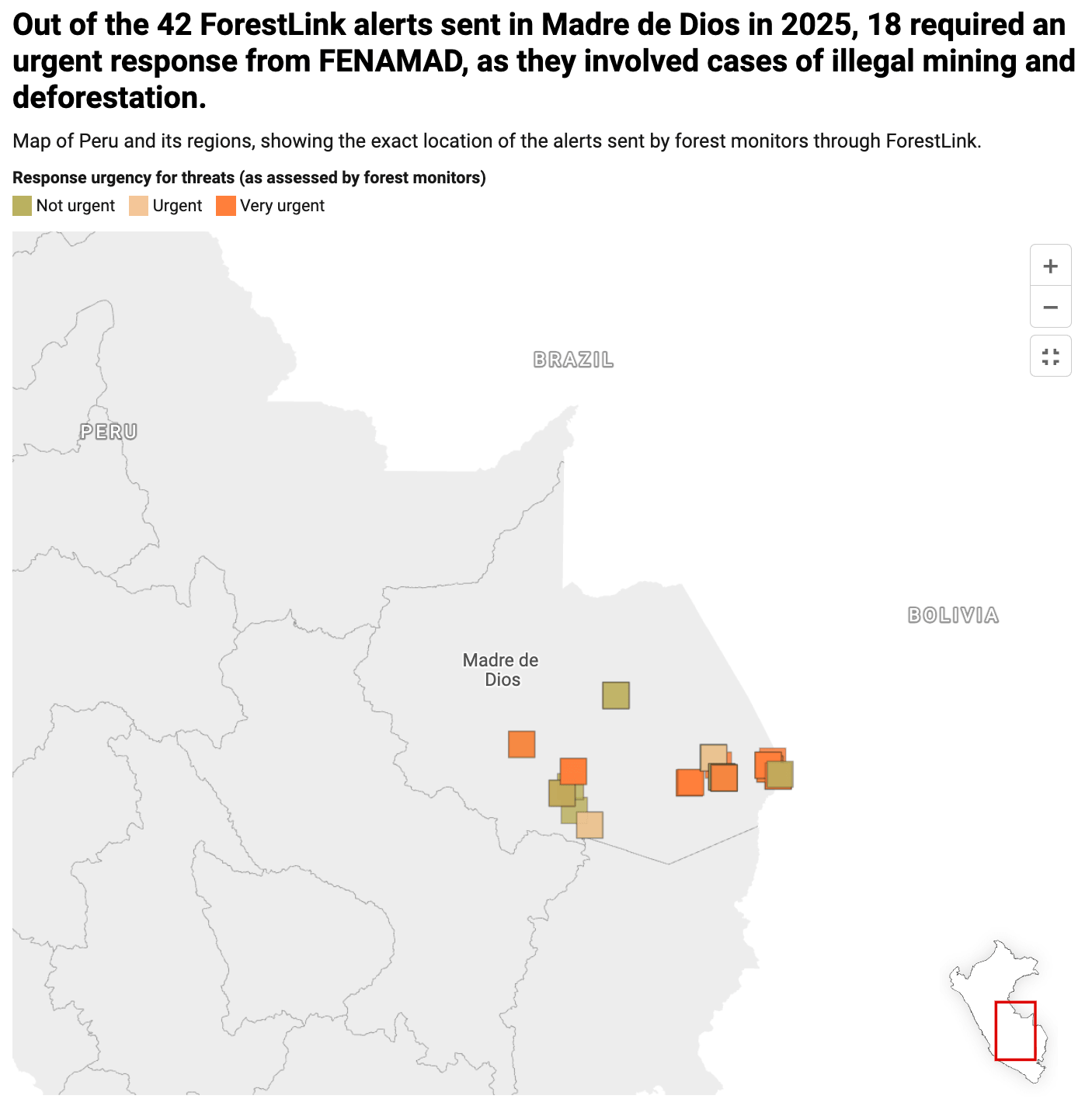
- 42 alerts were submitted by observers using ForestLink;
- 18 of these alerts were related to deforestation and illegal mining;
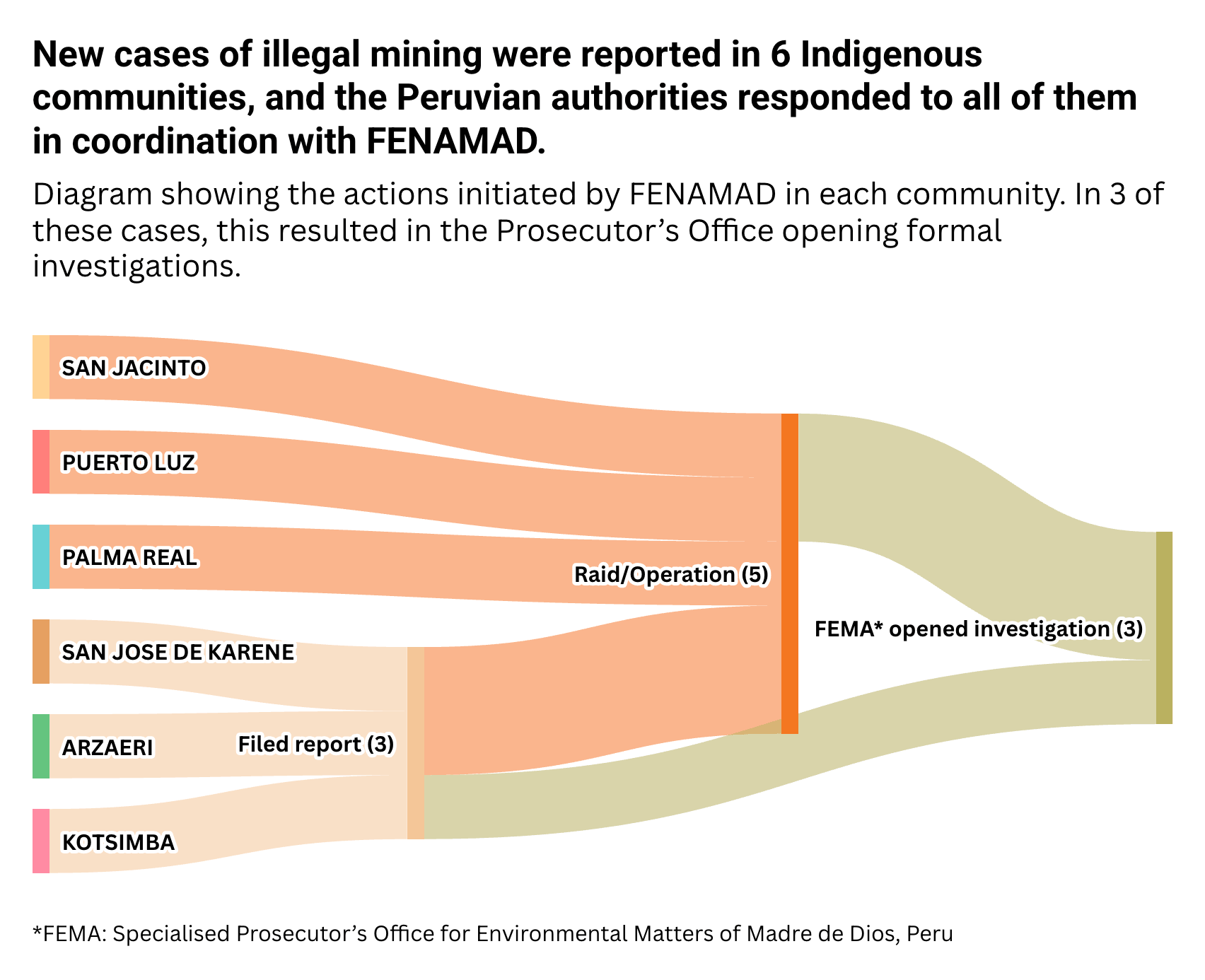
- 3 legal complaints were filed and all were accepted for investigation by FEMA, the Specialised Prosecutor's Office for Environmental Matters of Madre de Dios.
Across the year, additional cases contributed to multiple legal complaints and to at least 5 enforcement operations targeting illegal mining.
These operations, known as interdicciones, directly led to the destruction of machinery linked to illegal mining in several communities, further validating that Indigenous monitoring is directly informing state action.
Confronting a growing crisis
During RFUK’s visit in February 2026, community leaders described how illegal mining is expanding rapidly and becoming more dangerous.
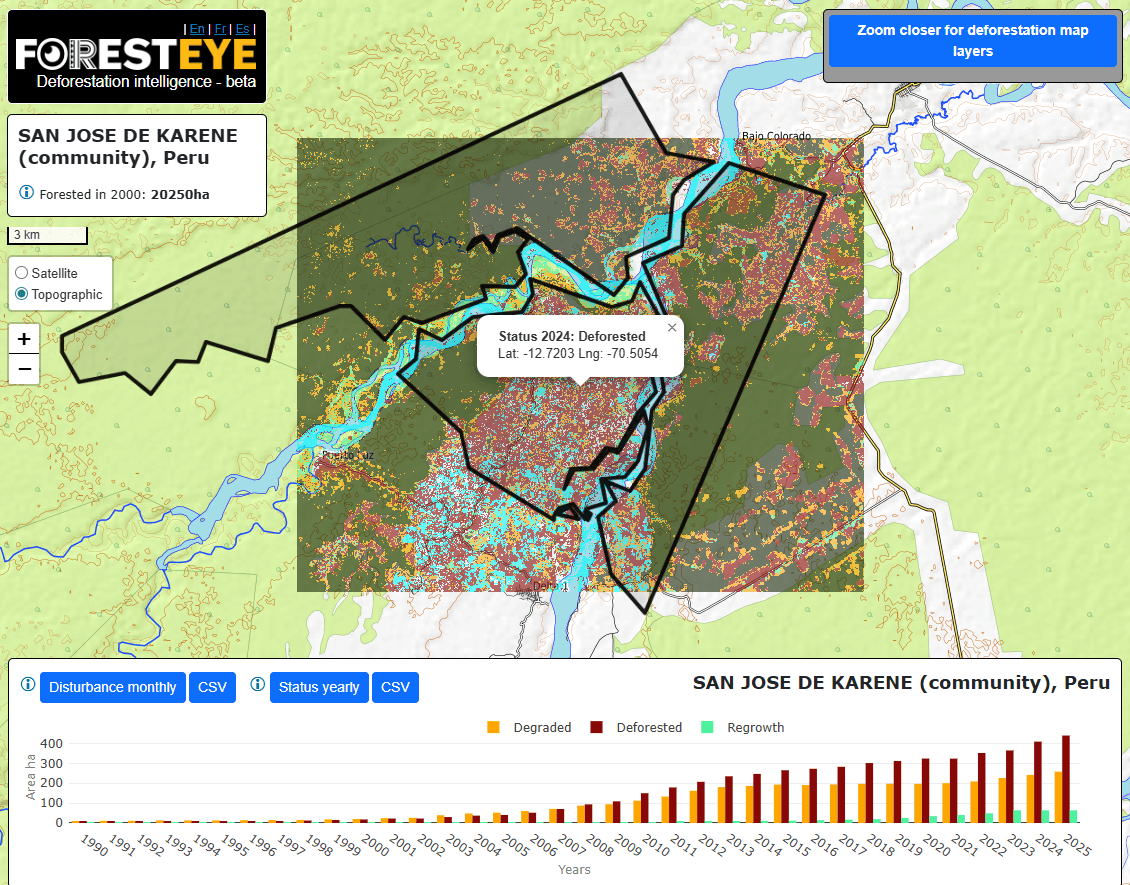
In some areas, observers shared that they now face armed groups and organised criminal networks. Entire communities are being reshaped by mining activity. San José de Karene, an Indigenous community in the Manu province of Madre de Dios, for example, is experiencing some of the highest levels of deforestation with approximately 70% of its territory affected. However, the impacts go far beyond deforestation. Many communities also suffer from mercury contamination, violence and intimidation, Indigenous youth being recruited and exploited as victims in illegal activities, and social instability and governance breakdown.
At least 79 Indigenous leaders are currently registered under Peru’s national protection mechanism, reflecting the level of risk faced by those defending their land.
Despite this, communities bravely continue monitoring.
Strengthening protection for defenders
RFUK’s work is increasingly focused on protecting the people behind the data.
Over the past year:
- 11 communities developed threat maps to improve monitoring safety;
- a new risk reporting form is being developed with government partners;
- legal capacity has been strengthened to support cases and respond to criminalisation.
These steps mark a shift from monitoring forests alone to defending both territory and rights, and ensuring protection for our defenders on the ground.
Indigenous leadership shaping policy
Indigenous organisations are responding to threats while continuing to influence decisions at the highest levels. FENAMAD has participated in multiple regional platforms, contributing to climate change strategies, biodiversity plans, regional environmental governance frameworks and mapping of degraded ecosystems.
This level of involvement ensures that Indigenous knowledge is not sidelined, but instead embedded in environmental policy.
Technology supporting safer monitoring
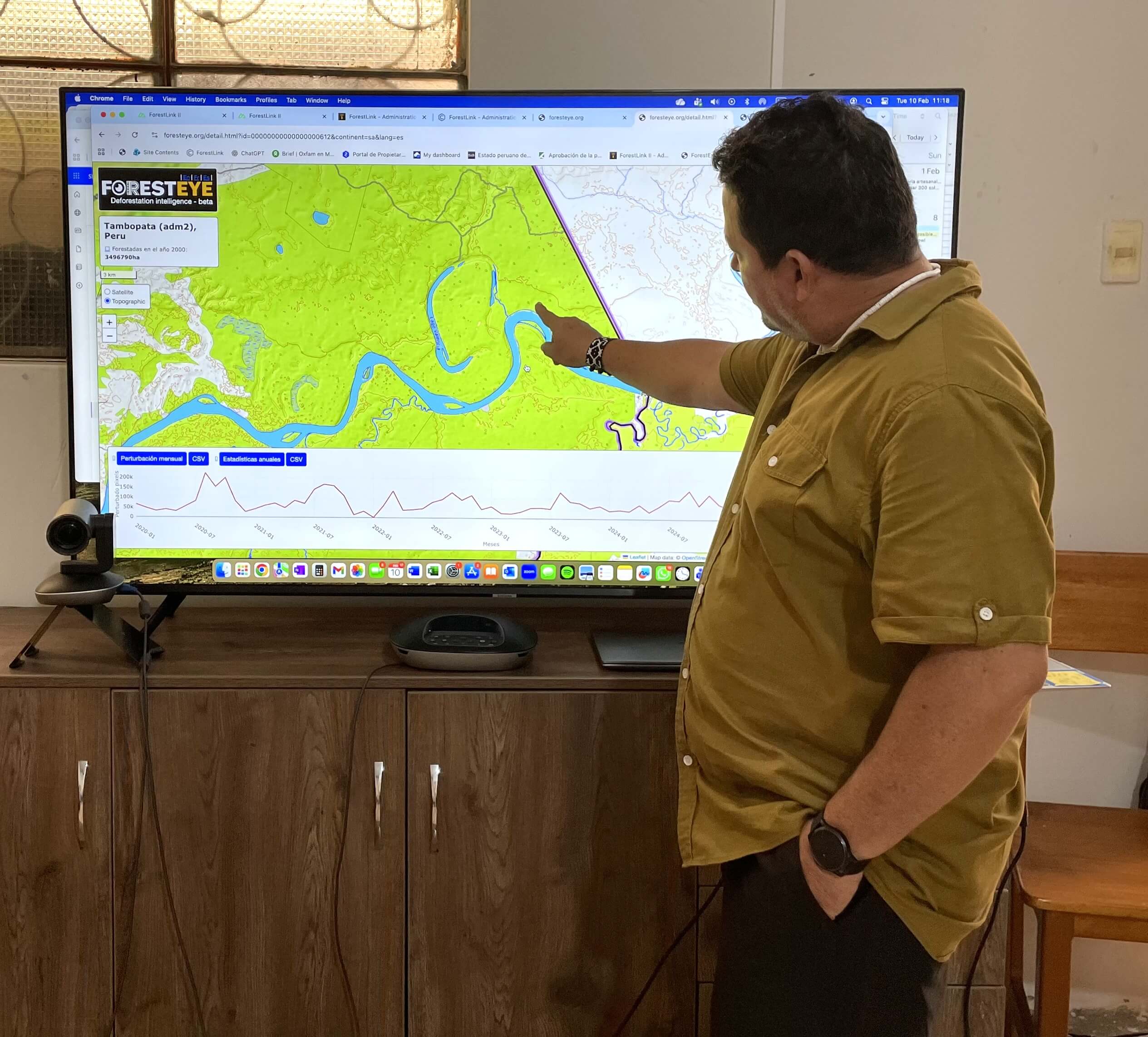
Our work continues to advance real-time reporting from remote areas and deforestation and early-stage degradation by combining community knowledge with cutting-edge tools such as ForestLink and ForestEye.
Together, these tools allow communities to identify threats earlier and avoid unnecessary risks in the field, strengthening both safety and effectiveness.
Looking ahead: scaling up, sustaining impact and strengthening protection
Our approach on the ground continues to evolve, and communities and partners are now exploring new ways to coordinate efforts across the region. These multi-community strategies reflect the reality that threats like illegal mining operate across territories, not within community boundaries.
A key priority is tackling the growing insecurity faced by forest monitors. A new risk reporting form is being developed in close coordination with government partners, particularly the Ministry of Justice, which leads the national protection mechanism for environmental defenders. This tool will be integrated into ForestLink and enable communities in remote and isolated areas to report threats more effectively, while strengthening coordination between FENAMAD’s legal team and state authorities.
At the same time, our work faces a critical challenge: sustaining the system. Current funding is supporting field training and the accreditation of monitors, which are essential to maintaining coverage as monitoring roles rotate. Without continued support, this capacity could be at risk.
A frontline effort to protect the Amazon
Our work shows what is possible when Indigenous communities are equipped with the tools, training and support to defend their territories.
It also highlights the risks they face.
As one key message from the visit made clear: environmental defence in the Amazon is increasingly a frontline activity and one where Indigenous communities continue to lead, despite the odds.
Our work in Peru has been made possible, in part, by the support of Size of Wales and the Waterloo Foundation.

Share this:

