
RFUK shares findings of gender study highlighting opportunities and barriers for women in forest governance in the Republic of Congo
06 April 2026
RFUK is sharing findings from a new gender study examining women’s participation in forest governance and community-based monitoring in the Republic of Congo. The study was conducted as part of the FISONG project, “Legal capacities and participation of environmental defenders in the Republic of Congo”, a programme implemented since 2022 by a consortium led by RFUK together with ClientEarth and the Congolese organisation, Comptoir Juridique Junior (CJJ). FISONG – an innovation funding mechanism created by Agence Française de Développement – supports pilot projects that test new approaches to development, with a strong focus on learning, evaluation and scaling impact. Through this initiative, partners aim to strengthen the rule of law, accountability and sustainable forest management by strengthening environmental defenders, particularly local communities and Indigenous peoples, through awareness-raising and capacity-building initiatives/activities.
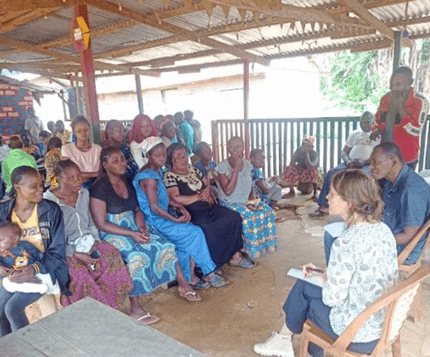
Through FISONG, community members are trained as community observers and paralegals, enabling them to monitor illegal activities linked to natural resource exploitation, report forest crimes via the ForestLink monitoring system and improve access to justice. As part of this work, the gender study adopted a participatory and interactive methodology to better understand the structural barriers and constraints faced by women in general, and Bantu and Indigenous women in particular, in the context of environmental management and forest protection.
Key findings and positive developments
The study highlights both enabling factors and obstacles to women’s participation. Some encouraging positive developments include:
- At the international, national and regional levels, the Republic of Congo has ratified multiple legal instruments protecting women’s rights, including those of Indigenous peoples, showing strong political commitment. Several public institutions and civil society organisations (CSOs) actively work to integrate gender into development policies and programmes, with increasing government budgets allocated to gender equality and women’s autonomy.
- Within the FISONG project, women participated in training programmes and were selected as both community observers and paralegals, though participation rates remained low specifically for the role of observers. In total, 20% of trained observers and 52% of trained paralegals were women, including 18% Indigenous women. Women reported feeling listened to, respected and supported, with a clear understanding of their roles.
- Communities generally regard female paralegals and observers positively, and many men interviewed expressed support for women taking on these roles. Focus groups revealed a growing desire among women to expand their autonomy, leadership and engagement in local initiatives.
Persistent structural and cultural barriers
Despite these advances, the study confirms that women’s participation remains limited due to deep-rooted structural, social and cultural barriers:
- Customary norms and gendered division of labour restrict women’s time and ability to engage fully in project activities. Married women often require consent from their husband to participate, and childcare and household responsibilities limit availability for monitoring or training.
- Discrimination and prejudice particularly affect Indigenous women, who may face exclusion, intimidation or bullying from Bantu men in mixed villages.
- Language and education gaps, as most Indigenous women cannot read, write or speak French, limit their access to information and thus limits access to project and employment opportunities, and their understanding of the law.
- Limited access to resources and services, including ID cards or citizenship documents, as well as the remoteness of monitoring sites and lack of financial support, further constrain participation.
- Legal and systemic gaps remain at the macro level: while the Republic of Congo has a relatively comprehensive legal framework for gender equality, implementation is uneven due to weak local awareness, conflicts with customary law and limited human and financial resources.
- Safety concerns, including reports of sexual violence in some northern Congo villages, discourage women from undertaking observation missions.
Recommendations for improving women’s participation
The study provides practical guidance across the micro, meso and macro levels:
- Community-level (micro): adapt project schedules to women’s daily responsibilities, provide training in French and local languages, raise awareness about women’s and Indigenous rights, organise women-only or culturally sensitive meetings where needed, support access to identification documents and implement leadership and legal literacy programmes. Exchange visits between communities with higher female participation were also recommended.
- Promote non-discrimination and inclusive attitudes (micro): implement targeted awareness-raising and training, particularly for Bantu men, on non-discrimination, gender equality and Indigenous peoples’ rights. This should aim to address deep-rooted prejudice, reduce intimidation and exclusion of Indigenous women and encourage more inclusive participation in decision-making processes.
- Project and organisations-level (meso): strengthen internal capacity on gender mainstreaming, develop and operationalise a gender policy and ensure staff receive relevant training.
- Government and national-level (macro): continue legal advocacy, review legislation for gender inclusivity and support participatory processes to translate gender equality commitments into tangible results.
Implications and next steps
For RFUK and the wider sector, the findings underscore that gender equality is not only a matter of fairness but a critical factor for effective forest governance. Supporting women as environmental human rights defenders strengthens accountability, enhances community engagement and ensures that those most closely connected to forest ecosystems are actively involved in protecting them.
By sharing these insights, RFUK aims to provide a practical resource for organisations designing and implementing community-based monitoring, environmental justice programmes and initiatives to support women’s participation in natural resource management.
Read the full gender study report here. The report is in French and an English version will soon be made available.
Share this:

