
Republic of Congo

RFUK and Greenpeace Africa express alarm at agreement that could lead to more environmental damage in the Republic of Congo
Following the meeting of global leaders at the UN climate summit in New York this week, Rainforest Foundation UK and Greenpeace Africa have raised the alarm that an agreement between the governments of Norway and France and the Republic of Congo to protect its rainforest and peatlands gives a green light to oil exploitation in … Read more

Real-Time Monitoring hits the ground running in the Republic of Congo
RTM Congo Team THE REAL-TIME MONITORING (RTM) CONGO TEAM, TRAINED BY RFUK IN 2019, HAVE CAPITALISED ON THEIR TECHNICAL TRAINING BY RFUK TO DEPLOY THE SYSTEM IN TWO PILOT SITES Comptoir Juridique Junior (CJJ) is deploying “Real Time Monitoring” (RTM) and the ForestLink technology in the Republic of Congo following their technical training by RFUK … Read more

The Green Climate Fund in the Congo Basin Rainforests – Good Money After Bad?
A report published by the Rainforest Foundation UK (RFUK) on the Green Climate Fund finds that one of the world’s largest climate adaptation and mitigation funds for developing countries may actually do more harm to tropical forests and people on the frontline of climate change unless it is reformed.

Yaoundé Declaration Declaration: Statement Concerning Community Forestry in the Congo Basin Region
Organisations and individuals from Central Africa, along with international partners from Europe, came together in Yaoundé in February 2019 to discuss the lessons from the recent years of community forest development in the Congo Basin, especially in the context of the projects funded through DFID’s ILLUCBF programme.
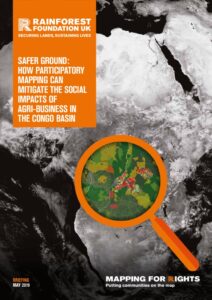
Safer Ground: How Participatory Mapping can Mitigate the Social Impacts of Agribusiness in the Congo Basin
The expansion of commercial agriculture in the Congo Basin, especially for palm oil, poses great risks to forests and the people who depend on them for their livelihoods and culture. While efforts to make palm oil more ‘sustainable’ focus on avoiding deforestation and biodiversity loss, far less attention has been paid to land rights and … Read more

Palmed Off: An Investigation into Three Industrial Palm Oil and Rubber Projects in Cameroon and the Republic of Congo
Research carried out by the Rainforest Foundation UK and its partner organisations found that industrial palm oil and rubber plantations in Africa’s Congo Basin continue to disrespect human rights and destroy large swathes of rainforests.
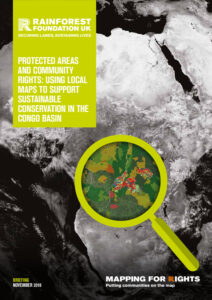
Protected Areas and Community Rights: Using Local Maps to Support Sustainable Conservation in the Congo Basin
The best conservation projects start with people. Yet protected areas in the Congo Basin continue to be established and managed with poor consideration for local communities’ land and resource rights, fostering conflicts and human rights abuses. A lot of these toxic situations could be avoided if thorough participatory community mapping data, such as collected through MappingForRights, … Read more

REDD and Rights in DRC: How Participatory Maps Can Inform the Mai-Ndombe Integrated REDD Programme
Forest tenure and resource mapping by local communities in Mai Ndombe is providing a highly detailed and comprehensive picture of customary claims and usages that are likely to extend across the entire province. The results, which authorised users can view on MappingForRights, have major implications for DRC’s flagship jurisdictional REDD+ programme, especially in terms of … Read more

Mapping For Rights: Putting Rainforest Communities on the Map
Since its launch in 2011, MappingForRights has supported more than a thousand communities to map and share highly detailed geographical information about their lands and resources so that decisions on forests do not neglect those who depend on them most. In this introductory briefing, we address the root causes land-based conflict in Central African forests, … Read more

The Human Cost of Conservation in Republic of Congo
This report is based on investigations in Republic of Congo by our local civil society partners, mainly within six forest communities living in or on the periphery of Conkouati-Douli National Park (CDNP) and Nouabalé-Ndoki National Park (NNNP). The aim of our investigations was to understand the impact of the protected areas on those communities and … Read more