
From the Ene River in Peru to the global stage: the journey of Nilda Chávez
08 mars 2026
This International Women’s Day, we celebrate the leadership of Indigenous women by sharing the story of Nilda Chávez whose journey from the Ene River to the global stage shows the power of community, determination and women’s leadership. At RFUK, we are proud to work alongside our partners and communities in Peru to help build the structures that enable Indigenous women’s leadership to flourish and forests across the Ene basin to be protected.
In November 2025, Nilda Chávez stood before an international audience at the UN Climate Conference (COP) in Brazil. Alongside CARE leaders Saúl Vega and Ángel Pedro Valerio, she represented the Asháninka communities of the Ene River on the eastern slopes of the Andes in Peru. Our partner CARE, the Central Asháninka del Río Ene, is an Indigenous federation representing 45 communities that works to strengthen local governance and community development. On stage, Nilda spoke about the work of AMA ENE, a group of Indigenous women strengthening women’s participation within CARE and advocating for better health services, education and infrastructure for families across the river basin.
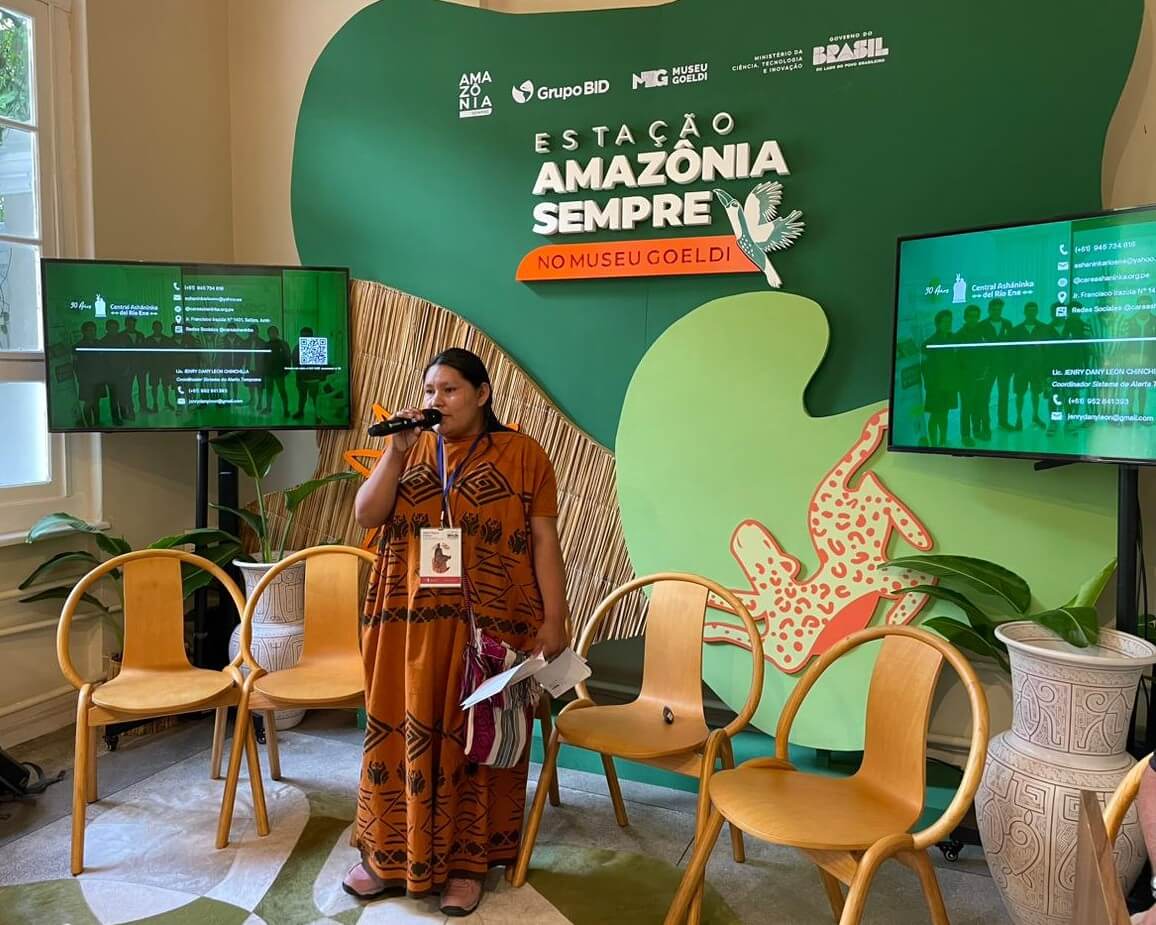
For Nilda, speaking on a global platform like this was almost unimaginable just months earlier. Until recently, she had never spoken in public. Her first experience addressing a crowd was in front of 500 Asháninka people. Soon after, she found herself speaking on behalf of 45 Indigenous communities and sharing their work with the world.
Her journey to COP began just seven months earlier, during CARE’s XXIX Ordinary Congress in April 2025, held in the community of Catungo–Quempiri. More than 500 people from the 45 communities represented by CARE gathered to elect a new Board of Directors that would guide the organisation for the next five years.

During the Congress, an unexpected moment changed the course of Nilda’s life. Florinda Yomiquiri, the outgoing Secretary of the Board, announced she could not continue her role due to family commitments. CARE’s statutes require a minimum number of women on the Board, meaning another woman needed to take her place.
Felixto Cabanillas, the president of Kemito Ene, knew Nilda through her work as a field technician, and her long-term dedication and commitment to the communities she had worked with, and put her name forward as a candidate. Kemito Ene is an Indigenous cooperative representing hundreds of Asháninka cocoa and coffee producers in Peru. Together with RFUK, it supports Asháninka families to produce sustainable, organic cocoa and sell it to international markets, improving livelihoods while protecting their ancestral forests.
Despite all the work Nilda was well known for in the Ene Valley, she had never imagined herself in such a position. She had no political experience, had never held a leadership role in her community and had never spoken in front of such a large gathering.
Standing before the assembly, she took the microphone and said simply, “I will try, I will learn and if I make mistakes, you can all punish me with nettle leaves,” she joked, referring to a traditional punishment among the Asháninka. The room filled with laughter. After discussion among the communities, the delegates placed their trust in her and elected Nilda as Secretary of CARE’s Board for the 2025–2030 term.

Nilda identifies as Nomatsiguenga through her father’s family and Asháninka through her mother’s. She grew up in Boca Saureni in the Ene River basin, one of seven siblings, and would become the first professional in her family.
Her path was not easy. At times, those around her expected her to stay at home caring for her daughters and working on the family chacra (small farm). But with the support of her parents and siblings, she continued studying.
In 2017, she won a scholarship to study intercultural administration in Lima. City life did not suit her, however, and she returned home. She soon realised she wanted to work with the land, with crops, forests and the rhythms of rural life.
Encouraged by a mentor, Daniel Quinchunga, who would later become General Manager of Kemito Ene, she pursued technical studies in agriculture and graduated as an agricultural technician. Over the following years she worked across the Ene region with local institutions, travelling between communities to support families with crop production, livestock and improved cooking stoves to strengthen families’ resilience and livelihoods.
In 2021 she joined CARE through Kemito Ene as a technician supporting cacao producers. The work meant long journeys and extended periods away from home, but it also allowed her get to know a new part of the Ene Valley and get to know and build strong relationships with thriving communities focused on producing cocoa and coffee for sale, giving her insight into successful, market-oriented livelihoods.

By the time she was elected to CARE’s board in 2025, her well-earnt reputation had already travelled across the Ene River basin, built through years of working closely with the communities she now represents.
Today, through her work with AMA ENE and CARE, Nilda helps strengthen Indigenous women’s participation and leadership across the organisation. Her journey, from a young technician in Boca Saureni to speaking on the global stage, reflects not only her determination, but also the trust of her communities, the guidance of mentors, the support of her family and the collective strength of Indigenous organisations working together.

After COP, Nilda returned home to the Ene River carrying more than her own experience. She brought with her the confidence of the communities who trusted her, the responsibility to amplify their voices and the commitment to continue building the structures that allow Indigenous women to lead, protect their forests and shape their future.
At RFUK, we are proud to support partners and communities in the Ene River basin who are strengthening Indigenous leadership and protecting their forests, and it was an honour to stand alongside Nilda and her colleagues as they shared their work at COP.

For more information about our work in Peru, please click ici or contact our Peru Coordinator, Daniela Velit.

Partagez ceci :


 English
  French
  Spanish