
Peru’s Supreme Court sets landmark precedent against intimidation lawsuits targeting Indigenous defenders
20 February 2026
In a landmark ruling, Peru’s Supreme Court has overturned a defamation judgment against the Indigenous rights organisation FENAMAD, recognising that a powerful timber company misused the justice system to silence public interest advocacy. The decision marks a major step forward in protecting freedom of expression and Indigenous rights, and sets an important precedent against so-called SLAPPs, Strategic Lawsuits Against Public Participation, in Peru.
The case dates back to July 2020, at the height of the COVID-19 pandemic. The Federación Nativa del Río Madre de Dios y Afluentes (FENAMAD), which represents Indigenous Peoples in the southern Peruvian Amazon, published alerts on social media warning of the heightened risk of disease transmission to the Mashco Piro, an Indigenous people living in voluntary isolation. FENAMAD cautioned that the restarting of logging activities near Mashco Piro territories could endanger their lives and called on the authorities to apply the principles of precaution, non-contact and territorial protection that govern the rights of isolated Indigenous Peoples.
Rather than addressing the concerns raised, the logging company Maderera Canales Tahuamanu S.A.C. responded by filing a defamation lawsuit against FENAMAD and its then president, Indigenous leader Julio Cusurichi. The company claimed that the social media posts damaged its honour and reputation.
In June 2021, a lower civil court in Puerto Maldonado ruled in favour of the company, ordering FENAMAD to pay fines and legal costs amounting to over 12,000 Peruvian soles (£2,625). The courts also required the organisation to publish a letter, drafted by the company, stating that the information it had shared in 2020 was false.
This type of legal action is known as a SLAPP, a lawsuit intended not to seek justice, but to intimidate critics, drain their resources and deter public participation. They are most often used by powerful corporate or political actors against civil society groups, journalists and environmental and human rights defenders.
Despite limited resources, FENAMAD kept challenging the ruling. With support from national and international allies, including RFUK and EarthRights International, FENAMAD filed a series of appeals and constitutional actions. While lower courts dismissed these efforts, often without addressing the broader human rights implications, the case eventually reached Peru’s Supreme Court. International legal experts also intervened by submitting an amicus curiae brief highlighting the global concern over SLAPPs and the protection of Indigenous defenders.
In July 2025, the Supreme Court issued its final judgment, finding that FENAMAD’s constitutional rights had been violated, including the right to due process, freedom of opinion and expression, and the right to properly reasoned judicial decisions. It annulled the earlier rulings and declared FENAMAD’s claims well-founded.
Crucially, the Court noted the long-standing tension between extractive industries and Indigenous Peoples living in or near affected territories, as well as the need to apply a preventive and intercultural approach when cases involve the rights of Indigenous Peoples, especially those living in isolation. The Court also ordered an end to the prior censorship imposed on FENAMAD.
FENAMAD’s Vice-President, Eusebio Ríos, welcomed the ruling as a victory that extends far beyond this individual case.
‘This is not only a legal victory, but a precedent that serves all Indigenous people and organisations defending the collective rights of Indigenous peoples. It strengthens our ability to demand that the State fulfil its obligations and ensures that companies do not dare to silence FENAMAD. We will not be intimidated’.
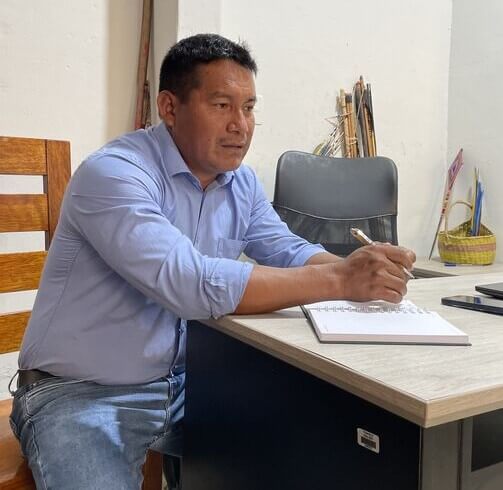
FENAMAD’s Vice-President, Eusebio Ríos, February 2026.
The ruling also highlights the vital role of independent forest monitoring. By working alongside partners such as FENAMAD to track logging activity and expose risks to Indigenous territories, RFUK helps ensure that forests are protected and that both companies and authorities are held accountable.
While the ruling does not explicitly use the term ‘SLAPP’, its reasoning aligns closely with international standards on abusive litigation. The Court held that forcing FENAMAD to publish a self-incriminating statement amounted to prior censorship, which is prohibited under the American Convention on Human Rights and the Inter-American Declaration of Principles on Freedom of Expression. It warned that such measures create a chilling effect, discouraging the reporting of potential human rights violations and weakening public oversight of powerful economic actors.
For human rights and environmental defenders, freedom of expression is not just an abstract right, it is their primary tool for protecting other rights. In Peru, many cases of criminalisation against environmental defenders take place in the context of extractive activities, and this case illustrates how fragile legal safeguards can be when corporations turn to the courts to silence criticism.
The Supreme Court’s decision is also significant because it explicitly recognises FENAMAD as an organisation of human rights defenders. Applying an intersectional approach, the Court acknowledged that FENAMAD represents Indigenous peoples who face overlapping forms of discrimination, including ethnic marginalisation, structural poverty and criminalisation due to their role in environmental defence. This recognition reinforces the state’s obligation to provide stronger protection.
However, the damage caused by the lawsuit cannot be undone entirely. After more than four years of legal proceedings, FENAMAD has borne significant financial, emotional and organisational costs, the very outcome SLAPPs are designed to produce.
Peru still lacks a specific anti-SLAPP law that would allow courts to quickly dismiss abusive lawsuits in matters of public interest, sparing defenders lengthy legal battles. Special Rapporteurs on freedom of expression within the Inter-American human rights system have repeatedly warned about the growing use of SLAPPs in the region. Although the Supreme Court halted the abuse in this case, lasting protection will require systemic reforms so that courts can identify and stop abusive litigation at an early stage.
As a partner of FENAMAD, RFUK reaffirms its unwavering support for the federation’s work and its leadership in defending the rights of Indigenous Peoples in the Peruvian Amazon. By highlighting this case, we seek not only to recognise a historic legal victory, but also to expose the systemic gaps that allow intimidation lawsuits to persist and to contribute to a necessary public debate on how to prevent them in the future.
SLAPPs have been increasingly recognised by courts and institutions worldwide, including landmark cases involving mining companies in South Africa and ongoing litigation brought by a U.S. fossil fuel company against Greenpeace. The European Union adopted an Anti-SLAPP Directive in 2024 to curb abusive cross-border lawsuits targeting public participation.

FENAMAD 44th annual Congress, January 2026.
For more information about our work in Peru, please click here or contact our Peru Coordinator, Daniela Velit.
Our work in Peru is made possible thanks to the generous support of Size of Wales.
Share this:


 English
  French
  Spanish