
English
World Bank Safeguard Policies
Proposed changes to World Bank safeguard policies will undermine decades of advances in indigenous peoples’ rights – Rainforest Foundation UK (RFUK) As the United Nations (UN), prepares to mark International Day of the World’s Indigenous Peoples tomorrow, August 9, the rights of the world’s indigenous peoples are now under greater threat by new policies being … Read more

Kemito Ene at Festival
Kemito Ene present their produce at Cocoa and Chocolate festival Peru More than 30,000 people attended the annual chocolate festival, Salon del Cocoa y Chocolate in Peru where producers, including Kemito Ene – the Asháninka indigenous cocoa association from the Ene River – showcased their products to the market and appealed to prospective buyers. At … Read more

RFUK’s Peruvian Amazon partner wins prestigious environmental award
RFUK’s Peruvian Amazon partner wins prestigious environmental award Ruth Buendía, an Asháninka woman and President of the Rainforest Foundation UK’s (RFUK) indigenous partner organisation in Peru, was awarded the 2014 Goldman Environmental Prize for her work to unite the Asháninka people around a campaign against large scale dams that would have uprooted indigenous communities. Ruth has been … Read more
RFUK embarks upon a new era in its Mapping and Forest Governance in the Congo basin
RFUK embarks upon a new era in its Mapping and Forest Governance in the Congo Basin The Rainforest Foundation UK (RFUK) alongside its local NGO partner FODER (Forêts et Développement Rurale) has embarked upon a new phase in the Mapping and Forest Governance in the Congo Basin by extending project activities into Cameroon. This project … Read more
Meet the Community Lawyers
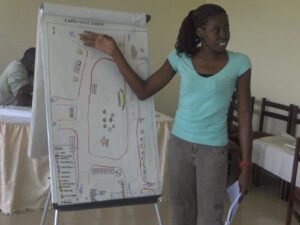
The Rainforest Foundation (RFUK) develops special field programmes for teams of young African lawyers known as Community legal field workers (CLFWs) to work with forest communities, indigenous peoples and local organisations to help them defend community rights in relation to land and resources, confront abuses of forest peoples’ rights and obtain essential legal documents such … Read more
Democratic Republic of Congo Forest Communities Present Maps and Ideas for Future Management of the Tumba-Ledima Protected Area
Democratic Republic of Congo Forest Communities Present Maps and Ideas for Future Management of the Tumba-Ledima Protected Area Over 30 forest community representatives from Inongo and Lukoléla Territories presented their participatory maps at a two-day multi-stakeholder workshop about the future management of the Tumba-Ledima Reserve in the Democratic Republic of Congo, (DRC) in March. The … Read more
Extension of Participatory mapping project in Ingende, Province of Equateur Democratic Republic of Congo
Extension of Participatory mapping project in Ingende, Province of Equateur Democratic Republic of Congo (DRC) The Rainforest Foundation (RFUK) and its local NGO partner, the Groupe D’action pour Sauver L’Homme et son Environnement (GASHE) will expand RFUK’s current participatory mapping project to the Ingende Territory which will involve up to 200 local and indigenous communities. … Read more

RFUK Press Conference
Amazonian Chiefs appear at London Press Conference to highlight accelerating threats to their rights and the rainforest Renowned Amazonian tribal Chief Raoni Meturktire and his nephew Chief Megaron Txucarramãe appeared at a press conference hosted by the Rainforest Foundation UK, RFUK, on Monday at the Frontline Club, London with Bianca Jagger being a keynote speaker. … Read more
Press Release – England Challenged to Game by Brazilian Rainforest Tribe
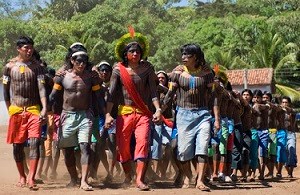
ENGLAND CHALLENGED TO GAME BY BRAZILIAN RAINFOREST TRIBE England’s world cup team have been challenged to a football game by one of Brazil’s largest and fiercest native Amazonian people, the Kayapó. In a letter today to England Manager, Roy Hodgson, Chief Raoni Metuktire and Chief Megaron Txucarramae, have invited the squad to their rainforest territory … Read more
School Fundraiser Success
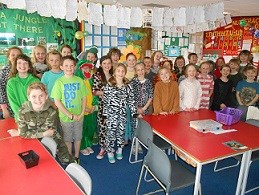
SCHOOL RAISES ALMOST £400 FOR RFUK ON THEIR ‘RAINFOREST DAY’ Excited and enthralled by their topic, Year 5 at Aughton Christ Church School in Lancashire, arrived to a rainforest themed classroom with ‘Explorer Swift’ (A.K.A their teacher – Mr Swift) greeting them as they entered. Throughout the morning, the children took part in rainforest games … Read more
 English
  French
  Spanish