
Protecting those who protect the forest: RFUK publishes new guidance to support community defenders in the Congo Basin
28 April 2026
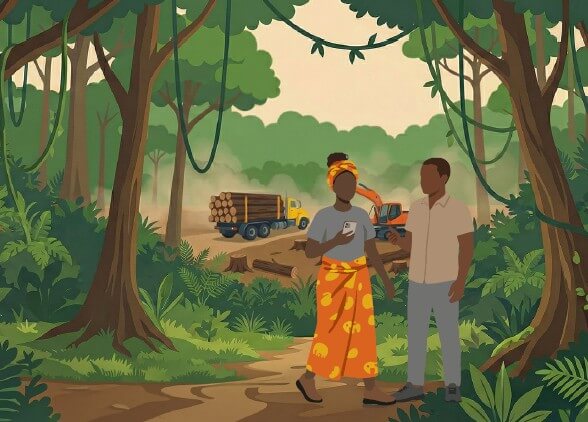
Deep in the forests of the Congo Basin, documenting illegal logging, or other illegal extractive activities, can come at a cost. Community observers, many of them volunteers, set out to monitor forest activity to protect their lands, defend their rights and ensure that forest laws are respected, knowing they may face intimidation, threats or even arrest. Their work puts them in direct contact with powerful actors, from companies operating outside the law to individuals who see monitoring as a challenge to their authority. In these conditions, simply gathering evidence can become dangerous.
Yet these observers continue.
They are on the frontline of efforts to protect one of the world’s most important rainforests. Using tools like RFUK’s ForestLink, they send real-time alerts from remote areas, exposing illegal activities that might otherwise remain hidden. Their work helps safeguard forests, but it also defends the rights of the communities who depend on them. Without them, much of what happens in these forests would go unseen and unchallenged.
Frontline work, however, should not mean facing unnecessary risk.
Working closely with our partners across the region, Comptoir Juridique Junior (CJJ), Ecosystèmes et Développement (ECODEV), Forêts et Développement Rural (FODER), Groupe d’Action pour Sauver l’Homme et son Environnement (GASHE) and Réseau pour la Conservation et la Réhabilitation des Écosystèmes Forestiers (Réseau CREF), we have developed a new security brochure to help community observers stay safe while carrying out this vital work. The guidance builds directly on the experience of those in the field, turning real-life challenges into practical advice that can be used before, during and after monitoring missions.
The need for this became clear through our work in the Congo Basin. As community monitoring systems grew stronger and more widely used, so too did the risks faced by those using them. Observers often operate in complex environments shaped by shifting political dynamics, local tensions and competing economic interests. In these contexts, preparation and awareness can make a critical difference.
The brochure responds to this reality with a simple but important approach: make safety practical, accessible and relevant. Designed to be carried into the forest, it offers clear guidance that observers can draw on in real time. It encourages them to plan carefully, assess risks in advance, identify trusted contacts and ensure they have what they need before setting out. It also reinforces the importance of information security, recognising that how data is handled can directly affect personal safety.
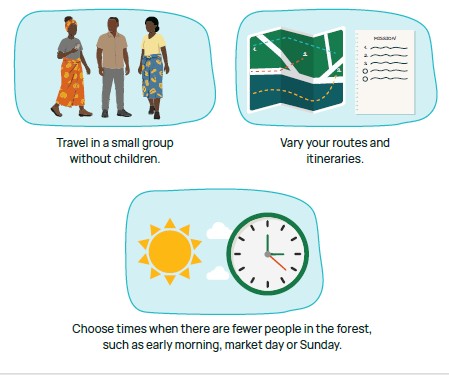
At its core is a strong message that no one should carry out monitoring alone. Travelling in small groups, varying routes and timings and keeping a low profile all help reduce risk. This focus on collective safety is especially important for women, who may face heightened threats, including gender-based violence. The guidance speaks directly to these realities, encouraging observers to adapt their approach based on their personal circumstances and to prioritise safety in every decision they make.
At the same time, the brochure acknowledges that not all risks can be avoided. It provides clear, practical advice on how to respond if something goes wrong, whether that means complying with demands in a threatening situation, moving quickly to a place of safety or reporting and documenting incidents afterwards. By learning from these experiences, observers and their organisations can continue to strengthen their approach to safety over time.
While this work is rooted in the Congo Basin, its relevance extends far beyond the region. Around the world, environmental human rights defenders are facing increasing pressure as they challenge illegal exploitation and push for more accountable and equitable forest governance. When those on the frontline are not adequately protected, the consequences reach far beyond individual communities, undermining global efforts to tackle deforestation, biodiversity loss and climate change.
By investing in practical tools like this security brochure, RFUK and its partners are taking an important step to address that gap. Supporting community observers means recognising that effective forest monitoring depends not just on technology or data, but on the people who make it possible. Their safety is fundamental.
The brochure will now be shared with partners and communities across our current and future projects, helping to strengthen safety practices on the ground. It also offers a starting point for other organisations working with environmental defenders to share their experiences.
The message is clear. Protecting forests starts with protecting the people who defend them. Ensuring their safety is not optional, it is essential.
See our new security brochure.

Share this:


 English
  French
  Spanish