
Carbon Offsetting & REDD+

Research into Mai Ndombe REDD+ Programme Shows How Forest Carbon Offsets Fail to Reduce Deforestation and Come at a Human Cost
A new study published today by Action pour la promotion et protection des peoples et espèces menacées (APEM) and the Rainforest Foundation UK (RFUK) finds that one of the world’s highest profile emissions reductions programmes is failing to uphold social safeguards, deliver local benefits, or prevent deforestation. The Mai Ndombe jurisdictional REDD+ programme in the … Read more

REDD-MINUS: The Rhetoric and Reality of the Mai Ndombe REDD+ Programme
A new study by Action pour la promotion et protection des peoples et espèces menacées (APEM) and the Rainforest Foundation UK (RFUK) finds that one of the world’s highest profile emissions reductions programmes is failing to uphold social safeguards, deliver local benefits, or prevent deforestation.

The Green Climate Fund in the Congo Basin Rainforests – Good Money After Bad?
A report published by the Rainforest Foundation UK (RFUK) on the Green Climate Fund finds that one of the world’s largest climate adaptation and mitigation funds for developing countries may actually do more harm to tropical forests and people on the frontline of climate change unless it is reformed.

REDD and Rights in DRC: How Participatory Maps Can Inform the Mai-Ndombe Integrated REDD Programme
Forest tenure and resource mapping by local communities in Mai Ndombe is providing a highly detailed and comprehensive picture of customary claims and usages that are likely to extend across the entire province. The results, which authorised users can view on MappingForRights, have major implications for DRC’s flagship jurisdictional REDD+ programme, especially in terms of … Read more
Failing Forests: The World Bank’s flagship REDD+ programme ten years on
More than a dozen environmental NGOs have today written to the World Bank to call for the suspension of its flagship programme to reduce emissions from tropical deforestation and degradation (REDD+) on its tenth anniversary, expressing concern that the programme has not yet prevented a single gram of forest carbon from entering the atmosphere. The Forest … Read more

A Critical Analysis of the Safeguards Framework of the Mai Ndombe PIREDD Project
The safeguard plans as they currently stand are seriously flawed, inadequate to ensure proper protection against harm, and need substantial re-working, clarification and improvement.

Norwegian government priming a ‘carbon bomb’ in Congo’s rainforests?
Photo: Norway’s Climate and Environment Minister Vidar Helgesen, left, met with his counterpart in DRC in August 2016. A few weeks after the meeting, minister Robert Bopolo Mbongeza secretly issued two illegal logging concessions covering 4,000 square kilometres. These have still not been cancelled. The Rainforest Foundation UK (RFUK) has today written to Norwegian Prime … Read more
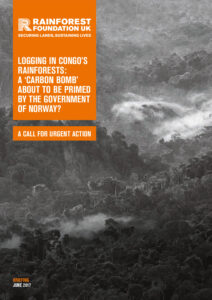
Logging in Congo’s Rainforests: A ‘Carbon Bomb’ About to be Primed by the Government of Norway?
In 2017, the government of Norway, through its ‘Central African Forests Initiative’ (CAFI), was considering providing financial support to a programme being developed by the French Development Agency (AFD) to greatly expand large-scale commercial logging in the rainforests of the Democratic Republic of Congo (DRC). This briefing outlines the potential impacts this proposal would have … Read more

Maï Ndombe est-elle prête pour la REDD ?
Tandis que le Comité des Participants du Fonds de partenariat pour le carbone forestier (FCPF) de la Banque mondiale approuve le projet Maï Ndombe, programme phare de la REDD en RDC, de nouvelles données sur les droits coutumiers dans la province jettent un doute quant à savoir qui bénéficiera du projet. Le programme de « … Read more

Climate Change Adaptation by Indigenous People in the Republic of Congo
As part of a regional study on indigenous peoples and climate change adaptation in Africa, the Rainforest Foundation UK (RFUK) coordinated desk and field research for the Republic of Congo, in collaboration with Congolese NGO Forum pour la Gouvernance et les Droits de l’Homme (FGDH) and local indigenous peoples’ organisations. The study recommends ways forward … Read more
 English
 French
 Spanish