
Community Forests and Land Rights

Just launched: “Forests for the Future” a 5-year community forestry project in DRC
With the support of USAID and Norad, the Rainforest Foundation UK and a consortium of Congolese organisations are launching “Forests for the Future,” a 5-year project supporting community forests and sustainable livelihoods in DRC. Kinshasa, July 7, 2021 – Senior representatives of the government (from the Ministry of Environment and Sustainable Development), the United States … Read more

The Bamasobha community gains legal rights over their forest in North-Kivu, Democratic Republic of Congo
Women in Bamasobha participating in discussions which led their community to apply for a community forest. When the villages of the Bamasobha community sought legal recognition of their traditional forests, a village chief, M. Sweli Maliani, declared: “We asked for a Community Forest because this is how we can secure our land, and prevent poachers … Read more

How community forests can save Africa’s rainforests (and may even help prevent the next pandemic)
Ever since the Kayapo people of Brazil saved their ancestral forest from a destructive mega-dam project in 1989, the Rainforest Foundation has stood behind the conviction that securing land rights for Indigenous Peoples and local communities is the best way to also protect those forests. Evidence from around the world now backs us up: deforestation … Read more

Securing Customary Rights is Key to Sustainable Community Forestry
The laws in the Republic of Congo and the Central African Republic provide limited protection to indigenous peoples and local communities regarding access to land and forest resources. Often, logging concessions overlap their territories, restricting access to lands and resources. However, the development of community forests is gaining momentum in the region. These can help … Read more
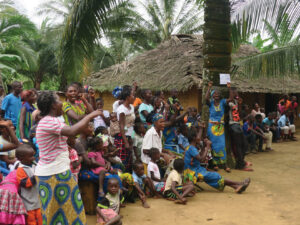
Community Forests change lives: How a Congolese community won rights to their forest
Ilinga received its official community forest title in September 2018 In September 2018, the community of Ilinga received its official community forest title. The community, whose traditional name means “Unity”, is one of eight in Equateur province in the Democratic Republic of Congo (DRC), supported by local NGO GASHE[1], as part of Rainforest Foundation UK’s DFID-funded … Read more

Women’s Participation in Community Forestry in the DRC
Based on a literature review and field research with communities in Equateur province, this study provides an overview of gender inequalities in the context of community forestry in the Democratic Republic of Congo. It also puts forward recommendations for improving women’s participation in community forestry activities.

Final Evaluation ILLUCBF Project – Democratic Republic of the Congo
This is the evaluation of the ‘Improving Livelihoods and Land Use in Congo Basin Forests’ (ILLUCBF) project, which was undertaken from June to August 2019 by a team of three independent external evaluators, based on the terms of reference provided by Rainforest Foundation UK (RFUK).
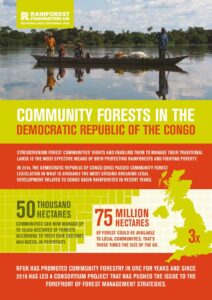
Community Forests in the Democratic Republic of the Congo
Strengthening forest communities’ rights and enabling them to manage their traditional lands is the most effective means of both protecting rainforests and fighting poverty. In 2014, the Democratic Republic of Congo (DRC) passed Community Forest legislation in what is arguably the most ground-breaking legal development related to Congo Basin rainforests in recent years.

Allocation of Community Forests in the Central African Republic
A process to test the legal framework on community forests is currently underway in CAR. For more than two years, local and indigenous communities have been supported by civil society in applying for the allocation of the pilot community forests. The process developed by those involved has been documented to provide a basis for a … Read more
Making Community Forestry Successful in DRC: Anthropological Perspectives on Community-based Forest Management
In 2014, the Democratic Republic of Congo (DRC) adopted ground-breaking legislation that enables forest communities to obtain “local community forest concessions” (CFCLs) of up to 50,000 hectares of their customarily owned lands, in perpetuity….
 English
  French
  Spanish