
Indigenous Peoples

Securing Customary Rights is Key to Sustainable Community Forestry
The laws in the Republic of Congo and the Central African Republic provide limited protection to indigenous peoples and local communities regarding access to land and forest resources. Often, logging concessions overlap their territories, restricting access to lands and resources. However, the development of community forests is gaining momentum in the region. These can help … Read more

Final Evaluation ILLUCBF Project – Democratic Republic of the Congo
This is the evaluation of the ‘Improving Livelihoods and Land Use in Congo Basin Forests’ (ILLUCBF) project, which was undertaken from June to August 2019 by a team of three independent external evaluators, based on the terms of reference provided by Rainforest Foundation UK (RFUK).

Asociación de Productores Kemito ‒ Ene (Peru), New Economy, Equator Prize 2019 Spotlight
In an area where forests are threatened by illegal logging, large infrastructure projects, and oil exploitation, Kemito Ene tells a story of indigenous entrepreneurship that sustains families and forests. This successful indigenous social business enterprise is a model for sustainable commodity supply chains worldwide. Kemito Ene advocates for the well-being of its producers based on … Read more
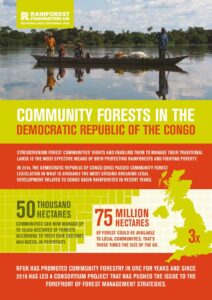
Community Forests in the Democratic Republic of the Congo
Strengthening forest communities’ rights and enabling them to manage their traditional lands is the most effective means of both protecting rainforests and fighting poverty. In 2014, the Democratic Republic of Congo (DRC) passed Community Forest legislation in what is arguably the most ground-breaking legal development related to Congo Basin rainforests in recent years.

Allocation of Community Forests in the Central African Republic
A process to test the legal framework on community forests is currently underway in CAR. For more than two years, local and indigenous communities have been supported by civil society in applying for the allocation of the pilot community forests. The process developed by those involved has been documented to provide a basis for a … Read more
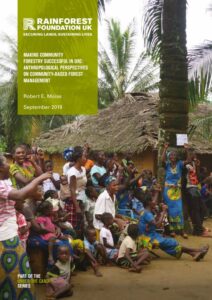
Making Community Forestry Successful in DRC: Anthropological Perspectives on Community-based Forest Management
In 2014, the Democratic Republic of Congo (DRC) adopted ground-breaking legislation that enables forest communities to obtain “local community forest concessions” (CFCLs) of up to 50,000 hectares of their customarily owned lands, in perpetuity….

Making Community Forests Work for Local and Indigenous Communities in the Central African Republic
As the Central African Republic (CAR) is entering a decisive phase that could lead to the allocation of the country’s first ‘pilot’ community forests, the Rainforest Foundation UK (RFUK) and CAR civil society groups are supporting local communities in their application processes.

Yaoundé Declaration Declaration: Statement Concerning Community Forestry in the Congo Basin Region
Organisations and individuals from Central Africa, along with international partners from Europe, came together in Yaoundé in February 2019 to discuss the lessons from the recent years of community forest development in the Congo Basin, especially in the context of the projects funded through DFID’s ILLUCBF programme.

Community-based Land-use Planning
In 2018, RFUK launched a new participatory mapping and land-use planning project in Maniema province, in the Democratic Republic of Congo (DRC). It aims to develop a community-driven model that will inform land-use planning at the local and national level, serving as an example for a more sustainable and equitable approach to land management.
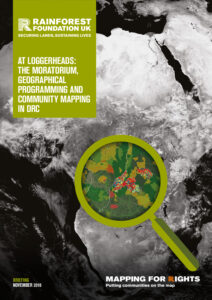
At Loggerheads: The Moratorium, Geographical Programming And Community Mapping In DRC
Of the three legal conditions attached to lifting DR Congo’s moratorium on new logging concessions, arguably only the third condition (on “geographic programming of future allocations”) remains to be fulfilled. Drawing on mapping data collected through MappingForRights and other sources, this briefing shows that any process which does not sufficiently take into account communities and … Read more
 English
  French
  Spanish