
Industrial Logging

Press Release: NGOs warn about lifting DRC logging ban
FOR IMMEDIATE RELEASE: LOOMING CLIMATE CATASTROPHE IF INTERNATIONAL COMMUNITY STAYS SILENT ON PLAN TO OPEN UP THE WORLD’S SECOND-LARGEST RAINFOREST TO INDUSTRIAL LOGGING, WARN NGOS In a letter to international climate funders, a group of leading environmental and human rights organisations warn of an impending climate and biodiversity catastrophe following a plan to lift a … Read more

Lifting DRC’s logging moratorium would be a disaster, warn NGOs
13 July 2021, Kinshasa – Greenpeace Africa, the Rainforest Foundation UK and the Rainforest Foundation Norway are alarmed over a plan announced by the Democratic Republic of Congo (DRC) Environment Minister Eve Bazaiba to lift a ban on new industrial logging concessions in the world’s second largest tropical forest. The national moratorium, which has stood since 2002 … Read more

Use It AND Lose It – Industrial Logging and its Role in Deforestation in the Democratic Republic of Congo
New research demonstrates a clear link between the establishment of commercial logging operations and a cascade of deforestation. Investigating forest loss in DRC across 60 logging concessions and eight ‘control’ areas, the findings from this study show that the selective logging of high-value timber species is not a sustainable form of forest management, but rather … Read more
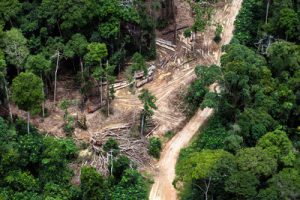
New RFUK Research Shows Link Between ‘Sustainable Forest Management’ and Deforestation in DRC
A new study published by RFUK establishes a clear link between selective logging and deforestation in the world’s second largest tropical forest. Despite being synonymous with high-level corruption, illegal practices and poor relations with local communities, selective logging of timber from tropical rainforests has long been promoted in the Congo Basin as a form of … Read more

RFUK supports civil society call for the immediate cancellation of three million hectares of illegal logging concessions in DRC
RFUK, Greenpeace and Congolese civil society groups are calling on the DRC Government to revoke three million hectares of illegal logging concessions or risk wrecking its image on the international climate stage. Last week it emerged that in June 2020 the Environment Minister Claude Nyamugabo had reallocated four logging titles covering 770,000 hectares to Groups … Read more
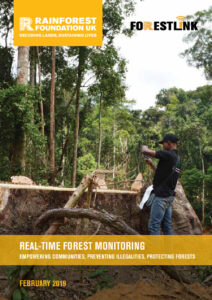
Real-time Forest Monitoring: Empowering Communities, Preventing Illegalities, Protecting Forests
Since its creation, ForestLink has been successfully deployed as part of RFUK’s Real-Time Forest Monitoring (RTM) initiative in Cameroon, the Democratic Republic of Congo (DRC), Ghana and Peru. By engaging forest and indigenous peoples in the fight against illegal logging and deforestation, RTM seeks to strengthen local involvement in forest management.
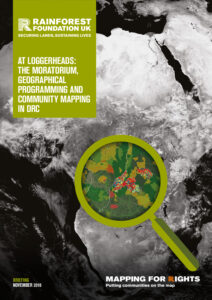
At Loggerheads: The Moratorium, Geographical Programming And Community Mapping In DRC
Of the three legal conditions attached to lifting DR Congo’s moratorium on new logging concessions, arguably only the third condition (on “geographic programming of future allocations”) remains to be fulfilled. Drawing on mapping data collected through MappingForRights and other sources, this briefing shows that any process which does not sufficiently take into account communities and … Read more

Government of Norway gives green light to continuing massive illegalities in Congo’s rainforests
The government of Norway is today accused by RFUK of encouraging impunity for serious wrong-doing, by failing to insist that illegal logging concessions in the Democratic Republic of Congo are immediately terminated. Responding to recent requests from Rainforest Foundation UK that it should refuse funding to a huge expansion of logging in the DRC, and … Read more
Logging in Congo’s Rainforests: A ‘Carbon Bomb’ About to be Primed by the Government of Norway?
In 2017, the government of Norway, through its ‘Central African Forests Initiative’ (CAFI), was considering providing financial support to a programme being developed by the French Development Agency (AFD) to greatly expand large-scale commercial logging in the rainforests of the Democratic Republic of Congo (DRC). This briefing outlines the potential impacts this proposal would have … Read more

Real-time Community-based Forest Monitoring: Challenges and Opportunities
This briefing presents the main findings from a study and consultation covering nine countries, conducted for The Rainforest Foundation UK in April 2015. It follows the successful technical testing in Cameroon of RFUK’s ForestLink technology.
 English
  French
  Spanish