
DR Congo

Statement: Protected areas in the Democratic Republic of Congo – a broken system
Statement: Protected areas in the Democratic Republic of Congo – a broken system 25th January 2021 Peoples and ecosystems in the Democratic Republic of Congo are being failed by the way conservation is practised. Indigenous Peoples and local communities face frequent threats of intimidation, torture, beatings, sexual violence and death at the hands of ecoguards … Read more
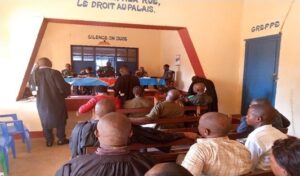
Huge leap in fight against impunity for conservation-related abuses in DRC as park rangers are sentenced for rape and torture
On 28 December 2020, five park rangers accused of raping and torturing four women in DRC’s Salonga National Park were convicted by the Military Court in Mbandaka, following a long battle for justice supported by the Rainforest Foundation UK (RFUK) and its local partner Actions pour la Promotion et Protection des Peuples et Espèces Menacés … Read more

REDD-MINUS: The Rhetoric and Reality of the Mai Ndombe REDD+ Programme
A new study by Action pour la promotion et protection des peoples et espèces menacées (APEM) and the Rainforest Foundation UK (RFUK) finds that one of the world’s highest profile emissions reductions programmes is failing to uphold social safeguards, deliver local benefits, or prevent deforestation.
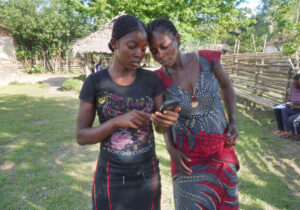
Forestlink: Unlocking the potential of forest guardians and environmental defenders in tackling illegal logging in DRC
With support from the UK Department for International Development (DfID), the Rainforest Foundation UK (RFUK) has been successfully developing and testing a ground-breaking new end-to-end system that is unlocking the potential of traditional forest guardians in monitoring and protecting their forests. ForestLink enables communities anywhere in the world to capture and transmit highly accurate reports … Read more
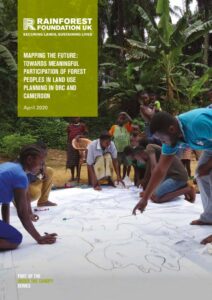
Mapping the Future: Towards Meaningful Participation of Forest Peoples in Land-use Planning in DRC and Cameroon
This RFUK report charts way to better inclusion of forest communities in Congo Basin land use planning processes.

Securing Customary Rights is Key to Sustainable Community Forestry
The laws in the Republic of Congo and the Central African Republic provide limited protection to indigenous peoples and local communities regarding access to land and forest resources. Often, logging concessions overlap their territories, restricting access to lands and resources. However, the development of community forests is gaining momentum in the region. These can help … Read more

DRC government suspends logging company after civil society reports illegal rainforest logging
A major illegal logging operation [1] has been halted by the Democratic Republic of Congo’s (DRC’s) government following monitoring by local non-governmental organisations and multiple complaints by forest communities. The DRC environment minister, last Friday (29th November), instructed the governor of the Tshopo Province to suspend the logging permit of the Chinese-owned FODECO [1] in … Read more

Women’s Participation in Community Forestry in the DRC
Based on a literature review and field research with communities in Equateur province, this study provides an overview of gender inequalities in the context of community forestry in the Democratic Republic of Congo. It also puts forward recommendations for improving women’s participation in community forestry activities.

Final Evaluation ILLUCBF Project – Democratic Republic of the Congo
This is the evaluation of the ‘Improving Livelihoods and Land Use in Congo Basin Forests’ (ILLUCBF) project, which was undertaken from June to August 2019 by a team of three independent external evaluators, based on the terms of reference provided by Rainforest Foundation UK (RFUK).
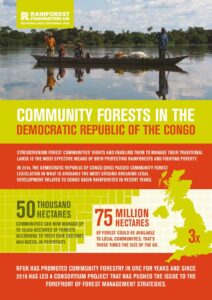
Community Forests in the Democratic Republic of the Congo
Strengthening forest communities’ rights and enabling them to manage their traditional lands is the most effective means of both protecting rainforests and fighting poverty. In 2014, the Democratic Republic of Congo (DRC) passed Community Forest legislation in what is arguably the most ground-breaking legal development related to Congo Basin rainforests in recent years.