
French

Lifting DRC’s logging moratorium would be a disaster, warn NGOs
13 July 2021, Kinshasa – Greenpeace Africa, the Rainforest Foundation UK and the Rainforest Foundation Norway are alarmed over a plan announced by the Democratic Republic of Congo (DRC) Environment Minister Eve Bazaiba to lift a ban on new industrial logging concessions in the world’s second largest tropical forest. The national moratorium, which has stood since 2002 … Read more

Just launched: “Forests for the Future” a 5-year community forestry project in DRC
With the support of USAID and Norad, the Rainforest Foundation UK and a consortium of Congolese organisations are launching “Forests for the Future,” a 5-year project supporting community forests and sustainable livelihoods in DRC. Kinshasa, July 7, 2021 – Senior representatives of the government (from the Ministry of Environment and Sustainable Development), the United States … Read more

Use It AND Lose It – Industrial Logging and its Role in Deforestation in the Democratic Republic of Congo
New research demonstrates a clear link between the establishment of commercial logging operations and a cascade of deforestation. Investigating forest loss in DRC across 60 logging concessions and eight ‘control’ areas, the findings from this study show that the selective logging of high-value timber species is not a sustainable form of forest management, but rather … Read more
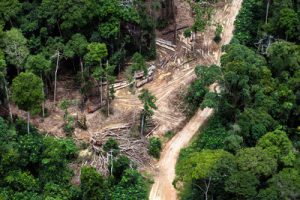
New RFUK Research Shows Link Between ‘Sustainable Forest Management’ and Deforestation in DRC
A new study published by RFUK establishes a clear link between selective logging and deforestation in the world’s second largest tropical forest. Despite being synonymous with high-level corruption, illegal practices and poor relations with local communities, selective logging of timber from tropical rainforests has long been promoted in the Congo Basin as a form of … Read more

Upcoming: Webinar Series debating Nature-Based Solutions for Climate Change
Rainforest Foundation UK and World Resources Institute are hosting a two-part webinar series and debate exploring the political ecology of Nature-Based Solutions Webinar series Nature-Based Solutions for Climate Change: Reconciling the Good, the Bad and the Ugly May 10 and May 17, 2021 9:00 AM – 10:30 AM EDT / 2:00 PM – 3:30 PM … Read more

First-ever Baka chief officially recognised in southern Cameroon—his majesty Martin Abila of the village Assok
For the first time in Southern Cameroon, an Indigenous Baka village has been officially recognised and their chief formally installed by the Cameroonian state. This marks a significant milestone in a country where Indigenous Peoples face extreme social, political and economic marginalisation. The installation of his Majesty Martin Abila as official chief of the village … Read more

Civil Society in the Congo Basin Sets Out Vision for Climate Change Mitigation and Adaption
Civil society organisations in the Democratic Republic of Congo (DRC) and the Republic of Congo (RoC) are calling for much greater inclusion of forest communities and forest governance reforms in their governments’ plans to address the climate crisis. In the run up to this year’s crucial climate summit in Glasgow this November, countries around the … Read more

The Bamasobha community gains legal rights over their forest in North-Kivu, Democratic Republic of Congo
Women in Bamasobha participating in discussions which led their community to apply for a community forest. When the villages of the Bamasobha community sought legal recognition of their traditional forests, a village chief, M. Sweli Maliani, declared: “We asked for a Community Forest because this is how we can secure our land, and prevent poachers … Read more

Celebrating women in leadership: experiences of women in the fight to protect the world’s rainforests
RFUK has long understood that women have a central role to play in protecting and managing the world’s rainforests. They are the main providers of food, water and medicine to their families, who depend greatly on rainforests for their livelihoods. They hold vast traditional knowledge of their forests and their biodiversity. This understanding informs our … Read more

How community forests can save Africa’s rainforests (and may even help prevent the next pandemic)
Ever since the Kayapo people of Brazil saved their ancestral forest from a destructive mega-dam project in 1989, the Rainforest Foundation has stood behind the conviction that securing land rights for Indigenous Peoples and local communities is the best way to also protect those forests. Evidence from around the world now backs us up: deforestation … Read more
 English
  French
  Spanish