
Indigenous Land and Livelihoods

ForestLink app helps catch illegal miners red-handed in Peru
Environmental police seized an estimated £1 million of illegal mining equipment during a raid near Barranco Chico, in Madre de Dios | Photo credit: FENAMAD Over the last two months, dozens of suspected illegal gold miners causing terrible environmental damage in the Peruvian Amazon were caught with the help of the ForestLink smartphone app developed by the Rainforest … Read more

Real-time technology helps stop illegal mining operation in the Peruvian Amazon
A map of the affected area in Madre de Dios region. An indigenous community in the Peruvian Amazon helped to catch illegal gold miners red-handed this month using a smartphone app developed by the Rainforest Foundation UK (RFUK), leading to the dramatic destruction of illegal mining equipment. The Masenawa community in Peru’s Madre de Dios … Read more

Asháninka cocoa growers sign landmark agreement
With support from the Rainforest Foundation UK (RFUK), Kemito Ene, the cooperative representing hundreds of Asháninka cocoa producers in Peru, has just signed an agreement to export 90 tonnes of certified organic cocoa for the international market. The agreement has been made possible in part thanks to a growing relationship with organic chocolate maker Loving … Read more

Amazonian Leader Receives Indigenous Award for Rights Advocacy
Amazonian leader receives indigenous award for rights advocacy Indigenous leader and Rainforest Foundation UK (RFUK) partner Ruth Buendía has been awarded the Bartolomé de las Casas prize for her commitment to standing up for the human and environmental rights of the Asháninka people in the Peruvian Amazon. The jury, acting for the Spanish Foreign Ministry’s … Read more
More awards for RFUK’s Peruvian partner Ruth Buendía
Ruth, who was also honoured with the prestigious Goldman Environmental Prize earlier this year, was awarded with a Diploma of Honour of the Republic at a special ceremony in September, chaired by the President of the Peruvian Congress, Ana María Solórzano, who recalled the moments in which the Asháninka suffered terrible violence at the hands … Read more

Kemito Ene at Festival
Kemito Ene present their produce at Cocoa and Chocolate festival Peru More than 30,000 people attended the annual chocolate festival, Salon del Cocoa y Chocolate in Peru where producers, including Kemito Ene – the Asháninka indigenous cocoa association from the Ene River – showcased their products to the market and appealed to prospective buyers. At … Read more

RFUK’s Peruvian Amazon partner wins prestigious environmental award
RFUK’s Peruvian Amazon partner wins prestigious environmental award Ruth Buendía, an Asháninka woman and President of the Rainforest Foundation UK’s (RFUK) indigenous partner organisation in Peru, was awarded the 2014 Goldman Environmental Prize for her work to unite the Asháninka people around a campaign against large scale dams that would have uprooted indigenous communities. Ruth has been … Read more

Press Release – Indigenous partner of RFUK in the Peruvian Amazon awarded prestigious international environmental prize
PHOTO: GOLDMAN ENVIRONMENTAL PRIZE INDIGENOUS PARTNER OF THE RAINFOREST FOUNDATION IN THE PERUVIAN AMAZON AWARDED PRESIGIOUS INTERNATIONAL ENVIRONMENTAL PRIZE An indigenous leader and long-term partner of The Rainforest Foundation UK, (RFUK), in the Peruvian Amazon is to receive the Goldman Environmental Prize – a prestigious accolade awarded to six grassroots environmentalists each year – at … Read more

Newsletter – Asháninka cocoa growers report record production levels for 2013
Asháninka cocoa growers report record production levels for 2013 The Asháninka cocoa and coffee association Kemito Ene (cocoa of the Ene River) which represents 200 Asháninka farmers achieved a production of 18 tonnes of cocoa during 2013 – seven tonnes more than the previous year. The creation of Kemito Ene forms part of an ongoing … Read more
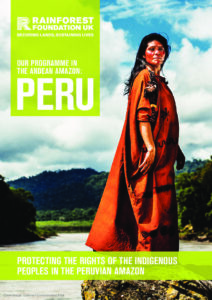
Peru: RFUK’s Programme in the Andean Amazon
RFUK has worked in Peru since 1998, supporting the indigenous peoples of the central Amazon forest region and the Vilcabamba mountain range to defend their lands and their right to lead a life in accordance with their culture and wishes. These mountain and forest regions are some of the most biodiverse ecosystems in the world.